
What is Stellar XLM?
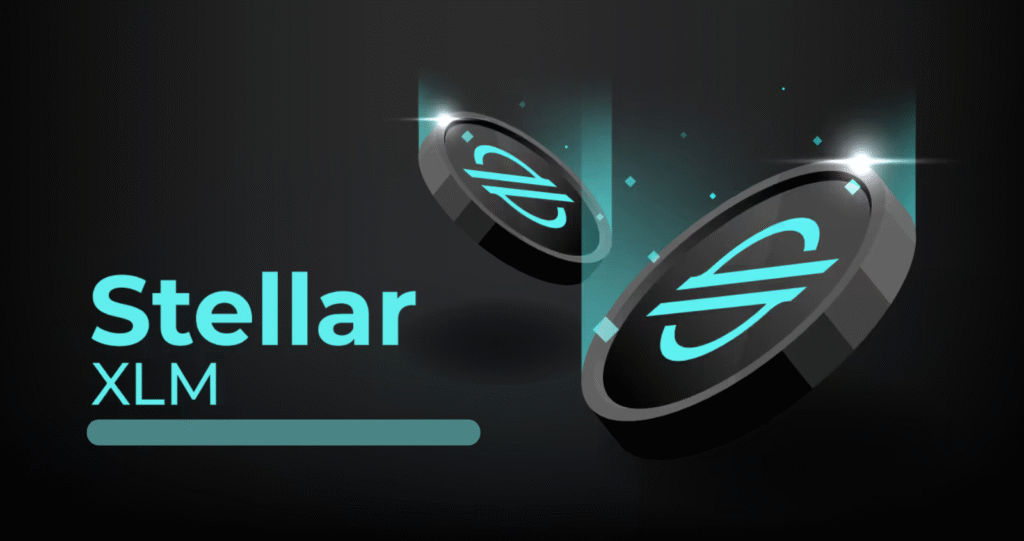
Stellar XLM is a blockchain-based payment network designed for fast, low-cost, and borderless transactions. Its native token is called Lumen (XLM). The main goal of Stellar is to make global money transfers as simple as sending an email.
Unlike many blockchains focused on decentralized apps, Stellar is built specifically for financial inclusion. It connects banks, payment providers, and individuals, enabling them to send and receive money across borders instantly.
History and Founders
Stellar was launched in 2014 by Jed McCaleb (co-founder of Ripple) and Joyce Kim. It was created as a non-profit project under the Stellar Development Foundation (SDF).
The aim was to solve problems with traditional banking and remittance services, such as high fees and long processing times. Stellar wanted to provide an open-source, decentralized system for fair financial access worldwide.
How does Stellar work?
Stellar uses the Stellar Consensus Protocol (SCP) instead of Proof-of-Work or Proof-of-Stake. This system allows transactions to confirm in 2–5 seconds with minimal energy use.
Key features of Stellar’s network:
- Validators: Independent servers run the consensus algorithm.
- Low fees: A transaction costs only 0.00001 XLM.
- Cross-border payments: Assets like USD, EUR, or BTC can move across the network.
Unlike traditional systems, Stellar does not rely on mining. Instead, it uses a trust-based system where participants agree on valid transactions.
Use Cases of Stellar
Cross-Border Payments
The Problem: Traditional international wire transfers are slow (taking 2-5 days), expensive (high fees and poor exchange rates), and opaque (you often don’t know the final amount the recipient will get).
How Stellar Solves This:
- Transactions on the Stellar network settle in 3-5 seconds.
- Transactions cost a tiny fraction of a cent (0.00001 XLM), making the cost of sending any amount of money negligible.
- Stellar doesn’t rely on a chain of correspondent banks. Instead, it uses a decentralized network of anchors (regulated entities that hold deposits and issue credits on the network). This removes intermediaries and streamlines the process.
Token Issuance
The Problem: Creating and managing digital assets (like stablecoins, loyalty points, or in-game currency) is technically complex and expensive on many blockchains.
How Stellar Solves This:
- Stellar’s protocol has built-in functions for creating, holding, and trading tokens. It’s designed to be simple for businesses and developers to implement.
- Anyone can issue a token on Stellar, defining its name, supply, and other properties with just a few commands.
- Issued tokens can be instantly traded on Stellar’s built-in Decentralized Exchange (DEX), where users can create offers to buy and sell assets. This provides immediate liquidity without needing to list on a major external exchange.
Micropayments
The Problem: Credit card networks charge merchants a fixed fee + a percentage (e.g., $0.30 + 2.9%), making transactions under a few dollars completely uneconomical. This kills potential business models like paying per article read or per second of video streamed.
How Stellar Solves This:
- Minuscule Fees: With fees being a fraction of a cent, sending a payment of $0.01 is entirely feasible. This opens up entirely new economic models.
Banking the Unbanked
The Problem: An estimated 1.4 billion adults worldwide lack access to basic financial services like bank accounts, savings, and credit. This excludes them from the global economy.
How Stellar Solves This:
- All you need is a smartphone and an internet connection. There are no minimum balance requirements or credit checks.
- Access to Global Markets: Stellar provides a gateway to global financial services like remittances, savings, and loans that are otherwise inaccessible.
In Essence, Stellar isn’t trying to replace banks for those who have them. Instead, it provides a foundational layer for financial services that can be built upon to serve those who have been left out of the traditional system.
Advantages of Stellar (XLM)
- Fast Transactions: 2–5 seconds confirmation time.
- Very Low Fees: Almost free transfers.
- Scalable: Supports thousands of transactions per second.
- Partnerships: Worked with IBM, MoneyGram, and Circle.
- Financial Inclusion: Helps underbanked regions access digital payments.
Challenges of Stellar (XLM)
- Competition: Faces rivals like Ripple, SWIFT, and other blockchains.
- Adoption: Needs broader global acceptance.
- Regulation: Unclear legal frameworks for cross-border crypto payments.
- Awareness: Many users still don’t know about Stellar compared to Bitcoin or Ethereum.
How to Invest in Stellar (XLM)
1. Choose an Exchange: Popular platforms: Binance, Coinbase, Kraken, or KuCoin.
2. Create an Account: Register, verify your identity, and enable two-factor authentication.
3. Deposit Funds: You can use fiat money (USD & EUR) or crypto to buy XLM.
4. Buy Stellar (XLM): Place a market or limit order.
5. Store Safely: Use wallets like Ledger, Trezor, or Lobstr Wallet for security.
Stellar Token (XLM)
- Ticker: XLM
- Max Supply: 50 billion
- Use Case: Paying transaction fees and preventing spam.
- Circulation: Billions of XLM are already in circulation.
Stellar originally issued 100 billion XLM, but later reduced the supply by half in 2019. This was done to improve scarcity and increase value stability.
Stellar vs Ripple (XRP)
| Feature | Stellar (XLM) | Ripple (XRP) |
| Purpose | Financial inclusion for individuals | Banking and institutional settlements |
| Founder | Jed McCaleb, Joyce Kim | Jed McCaleb, Chris Larsen |
| Consensus | Stellar Consensus Protocol | Ripple Consensus Algorithm |
| Transaction Cost | ~0.00001 XLM | ~0.00001 XRP |
| Target Users | Everyday users, unbanked population | Banks, large payment companies |
Stellar Price Prediction
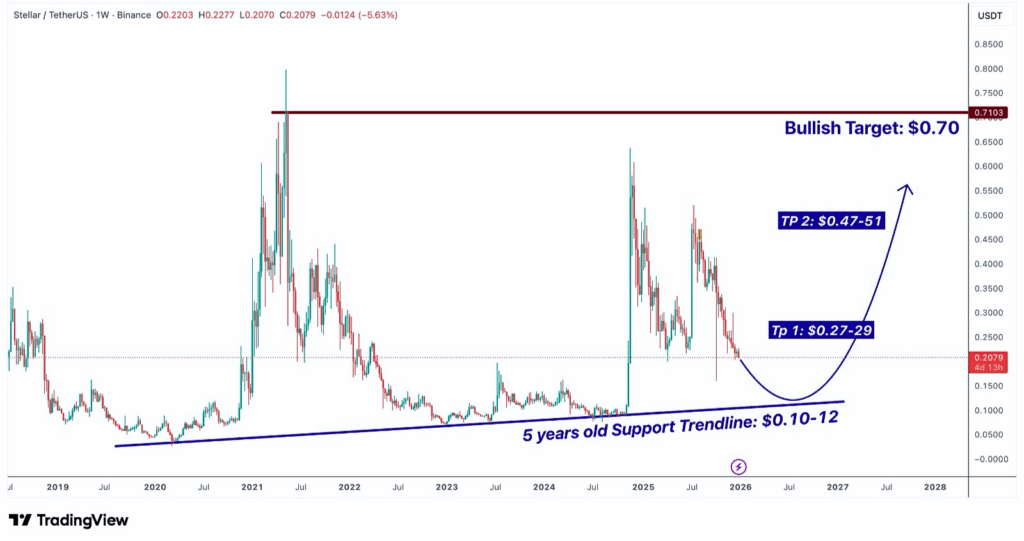
| Category | Projected Price (USD) |
| Projected High | $0.36 – $0.82 |
| Average Price | $0.30 – $0.71 |
| Projected Low | $0.24 – $0.43 |
| Major Resistance Zone | $0.30 – $0.45 |
| Major Support Zone | **$0.20 – $0.23** |
Its functions as a decentralized payment network designed to facilitate low-cost cross-border transactions and financial inclusion. During 2026, the ecosystem focuses on the widespread adoption of Soroban smart contracts, which enable complex decentralized applications and automated financial services. Furthermore, the network maintains its lead in Real-World Asset (RWA) tokenization, securing over $3 billion in institutional assets such as U.S. Treasury bonds. Strategic partnerships with global entities like MoneyGram and Franklin Templeton continue to bridge the gap between traditional finance and blockchain technology. Consequently, analysts expect gradual growth as the network integrates deeper into mainstream financial infrastructures.
Key Investment Drivers
- Leading firms utilize Stellar to issue digital versions of fiat currencies, real estate, and government bonds.
- The protocol upgrade enhances network scalability and allows developers to build sophisticated DeFi tools using the Rust-based smart contract platform.
- Partnership expansions with fintech providers streamline currency conversions and lower the cost of international money transfers.
- Stellar includes built-in KYC and AML features that help financial institutions meet strict global regulatory standards.
- The Stellar Consensus Protocol consumes minimal energy compared to mining-based systems, appealing to sustainability-focused institutional investors.
How to Calculate Stellar (XLM) Profits
Formula:
Profit = (Selling Price – Buying Price) × Number of XLM – Fees
Example:
- Bought 1,000 XLM at $0.08
- Sold at $0.12
- Fees: $2
Profit = (0.12 – 0.08) × 1000 – 2 = $398
Risks Involved in Stellar (XLM)
- Market Volatility: Crypto prices can swing rapidly.
- Regulatory Issues: Governments may restrict cross-border crypto payments.
- Competition: Other blockchains or fintech services could overtake Stellar.
- Security Threats: While Stellar is secure, wallets and exchanges may get hacked.
Disclaimer
- This article is for educational purposes only.
- It does not provide financial or investment advice.
- Cryptocurrencies, including Stellar (XLM), are volatile and risky.
- Always do your own research (DYOR) and consult a financial advisor before investing.
- Never invest more than you can afford to lose.
Frequently Asked Questions
Who is issuing assets on Stellar today?
Banks, fintech companies, stablecoin issuers, and payment platforms issue assets on the Stellar network.
What types of assets can be tokenized on Stellar?
Fiat-backed stablecoins, securities, loyalty points, and real-world financial assets can be tokenized on Stellar.
What is Stellar’s operational uptime?
Stellar consistently maintains high operational uptime due to its lightweight and efficient network design.
How fast are transactions on the Stellar network?
Stellar transactions typically settle in 3–5 seconds with very low transaction fees.
What consensus mechanism does Stellar use?
Stellar uses the Stellar Consensus Protocol (SCP), which enables fast, energy-efficient transaction validation.
How does Stellar support cross-border payments?
Stellar enables near-instant global transfers by connecting financial institutions through its decentralized exchange.
Who maintains and develops the Stellar network?
The Stellar Development Foundation (SDF) supports ecosystem growth and protocol development.
How decentralized is the Stellar network?
Stellar operates through independent validators globally, allowing open participation without mining.
What role does XLM play in the Stellar ecosystem?
XLM is used for transaction fees, account minimum balances, and network security.
How does Stellar compare to other payment blockchains?
Stellar focuses on speed, low fees, and financial inclusion, unlike general-purpose smart contract platforms.