Litecoin (LTC) launched in 2011 and remains one of the oldest cryptocurrencies. It was designed as a faster alternative to Bitcoin, often called “digital silver.” Litecoin focuses on payments, offering quicker confirmations and lower fees. Because of this, many users choose it for both transactions and investments.
History of Litecoin
Litecoin was founded by Charlie Lee, a former Google engineer and later director at Coinbase. He released Litecoin in October 2011. Bitcoin pioneered crypto but struggled with daily payments due to slow block times and higher fees during congestion. Charlie Lee improved this by modifying Bitcoin’s code, reducing block time, and changing the mining algorithm to create Litecoin.
Some key milestones:
- Launch date: October 2011.
- Litecoin coined the term “silver” to Bitcoin’s “gold” in its narrative.
- Litecoin enables faster transactions with lower costs. Its maximum supply is 84 million LTC, compared to Bitcoin’s 21 million. Over time, Litecoin has stayed among major cryptocurrencies due to strong infrastructure and real payment usage.
How Does Litecoin Work?
Litecoin works as a peer-to-peer digital currency on its own blockchain. It shares similarities with Bitcoin but includes improvements that make transactions faster and more usable.
1. Consensus & Mining
Litecoin uses a Proof-of-Work (PoW) consensus mechanism. It means miners use computing power to validate transactions and add new blocks. However, Litecoin differentiates itself by using the Scrypt hashing algorithm rather than Bitcoin’s SHA-256. This was originally chosen to make mining more accessible and less dominated by specialised hardware when the network started.
2. Faster Block Time
One of Litecoin’s major design adjustments is a block creation time of around 2.5 minutes. This means transactions can be confirmed more rapidly. Faster block times contribute to better usability for payments and smaller value transfers.
3. Supply & Economics
Litecoin’s maximum supply is capped at 84 million LTC (four times Bitcoin’s cap). This higher supply was part of the idea to make each unit more affordable and usable in everyday transactions. Like Bitcoin, Litecoin has halving events approximately every 840,000 blocks (about every 4 years). It reduces the block reward – supporting predictable issuance and scarcity over time.
4. Payment Network Features
Because Litecoin has faster block times and lower fees. It works well for peer-to-peer payments and everyday transactions. Moreover, its stable codebase supports merchant use and micro-transactions. Additionally, Litecoin often tests Bitcoin upgrades early, such as SegWit and the Lightning Network.
How to Buy Litecoin?
Purchasing Litecoin is similar to acquiring many other mainstream cryptocurrencies. Here is a simple breakdown:
- Choose a cryptocurrency exchange: Use a reputable platform that supports LTC trading (such as global exchanges or India-friendly ones).
- Complete KYC/registration: Most platforms require identity verification under local regulations.
- Deposit funds: You can use fiat currency (USD, INR, etc) or other crypto to deposit.
- Place a buy order: Next, find the LTC trading pair on the exchange, such as LTC/USDT or LTC/INR. Then, place a market or limit buy order.
- Transfer to a wallet (recommended for long-term): After purchase, move your LTC to a personal wallet. Moreover, use a hardware wallet for better security if you plan to hold long-term.
- Stay informed: Monitor transaction fees, network updates, and ensure you’re aware of risks (see disclaimer below).
What Are Litecoin Tokens Used For?
Litecoin tokens (LTC) serve multiple functions within the ecosystem:
- Medium of exchange: LTC is widely accepted as payment for goods and services, thanks to its faster confirmations and lower fees compared to some older networks.
- Store of value (to some degree): While Litecoin’s original mission was payments-friendly, many users treat LTC as a digital asset for investment or value retention.
- Network participation (via mining): Miners support the network’s security and in turn earn LTC as rewards for validating blocks.
- Lower-cost transaction option: Because of low fees, LTC works well for smaller value transfers or frequent payments where cost efficiency matters.
- Testing ground/infrastructure complement: First, Litecoin’s network works as a testing ground for upgrades that later help other blockchains. As a result, Litecoin stands beyond speculation and serves as a practical digital currency for fast, low-cost everyday payments.
Litecoin (LTC) Investment Projection
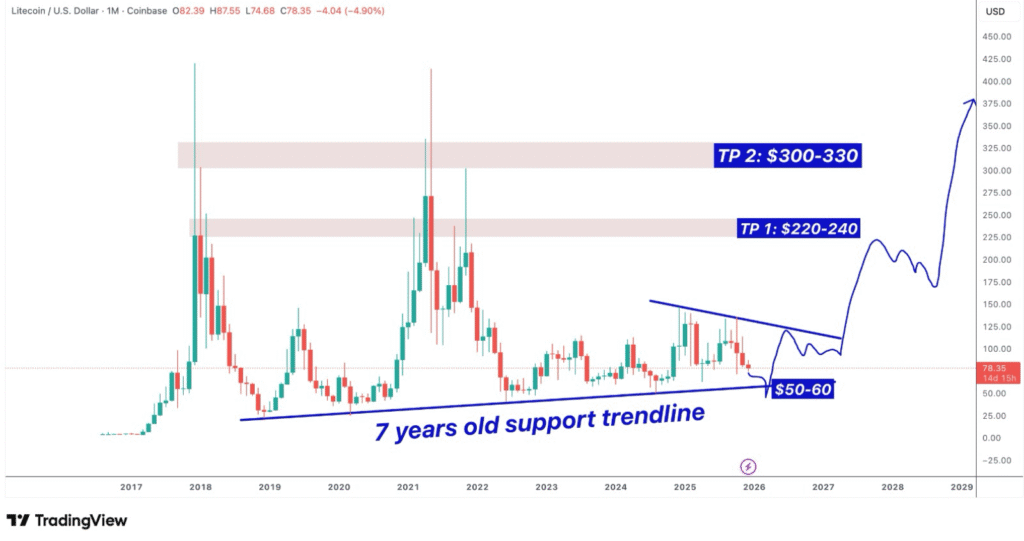
This table highlights the projected price levels and critical technical zones for 2026.
| Category | Projected Price (USD) |
| Projected High | $190.00 – $250.00 |
| Average Trading Price | $120.00 – $150.00 |
| Projected Low | $82.00 – $95.00 |
| Major Resistance Zone | $160.00 – $185.00 |
| Major Support Zone | $74.00 – $80.00 |
Assumptions & notes
Litecoin (LTC), often called “digital silver,” is entering an important phase in 2026. First, the network is moving beyond simple payments with the integration of LitVM, its Layer-2 solution. As a result, Litecoin now supports smart contracts and DeFi features. Moreover, possible U.S. ETF approvals and rising institutional interest strengthen its growth outlook. Although LTC still follows Bitcoin’s price trend, these upgrades and its fixed supply of 84 million coins support long-term potential.
Why is Litecoin better than its Competitors?
In the crowded crypto market, Litecoin competes with and complements several cryptocurrencies. First, many focus on payments, store of value, or network utility. Below, we compare key competitors and show how Litecoin stands out.
Key Competitors:
- Bitcoin Cash (BCH) — a fork of Bitcoin oriented toward payments.
- Ripple (XRP) — payment-focused asset/ledger targeting cross-border flows.
- Stellar (XLM) — a payments and asset issuance network for financial inclusion.
- Bitcoin (BTC) — the original, mostly viewed as digital gold rather than day-to-day payments.
Strengths of Litecoin:
- Maturity & track record: Litecoin has been around since 2011, making it one of the most established altcoins with real transaction history and ecosystem.
- Faster and cheaper transactions: With ~2.5-minute block times and lower fees (compared to older chains), Litecoin is well-suited for payments rather than just speculation.
- High supply (accessibility): The higher max supply (84 m vs 21 m for Bitcoin) means each unit is often more affordable, which helps adoption for payments.
- Complementary role: Instead of trying to replace Bitcoin, Litecoin often positions itself as a complement — a usable payments layer alongside the store-of-value narrative of Bitcoin.
- Infrastructure & merchant support: Litecoin is widely supported across exchanges and payment gateways, making it easier for adoption in commerce. (e.g., it is often recommended for payment acceptance).
Why Litecoin may have an edge?
Because Litecoin combines a strong legacy track record with practical payment attributes (speed, cost, accessibility) and broad infrastructure support. It stands out among payment-oriented cryptocurrencies. For users or merchants who prioritise reliable, faster, and cost-effective crypto transactions, Litecoin remains a compelling choice.
Conclusion
Litecoin (LTC) is a well-established cryptocurrency with a clear purpose. It serves as a swift, cost-effective digital payment medium — sometimes described as the “digital silver” to Bitcoin’s “digital gold”. With its faster block time, affordable fees, and mature ecosystem, Litecoin retains relevance in the cryptocurrency landscape.
While competition is fierce and the crypto market remains volatile. Litecoin’s track record and strong infrastructure make it a dependable crypto asset. It suits users who prefer real usability over purely speculative tokens. If adoption of digital payments grows and blockchain technology increasingly penetrates commerce, Litecoin is well-positioned to benefit.
However, success will depend on sustained development, merchant/consumer uptake, and favourable regulatory and macroeconomic conditions. For users and investors, Litecoin offers both utility and maturity—but like all crypto assets, it carries risk.
Disclaimer
Investing in cryptocurrencies like Litecoin (LTC) involves significant risk. The market is highly volatile, and prices can fluctuate widely in short periods. The price predictions above are hypothetical and should not be taken as financial advice or guarantees. Past performance is not indicative of future results. You should only invest money you can afford to lose. Consider consulting a qualified financial adviser before making any investment decisions. Diversification and responsible risk management are strongly recommended.
FAQs
What is Litecoin (LTC)?
Launched in 2011, it is a peer-to-peer cryptocurrency designed to provide faster and cheaper transactions than Bitcoin.
What is the maximum supply of LTC?
The total supply is strictly capped at 84 million coins, making it a scarce digital asset.
What is LitVM?
LitVM is an EVM-compatible Layer-2 rollup that enables smart contracts and decentralized applications (dApps) on the Litecoin network.
When is the LitVM testnet launching?
The public testnet for LitVM is slated for launch in Q1 2026.
How often does Litecoin’s halving occur?
Like Bitcoin, Litecoin undergoes a block reward halving approximately every four years to manage inflation.
Is there a Litecoin ETF?
As of late 2025, several applications for Litecoin spot ETFs are under regulatory review.
What are the main advantages of using LTC?
It offers significantly lower transaction fees and 4x faster block confirmation times (2.5 minutes) than Bitcoin.
What is MWEB?
MimbleWimble Extension Block (MWEB) is an upgrade that provides optional privacy and better scalability for Litecoin transactions.
Who is the creator of Litecoin?
Litecoin was created by Charlie Lee, a former Google engineer and early crypto pioneer.
What is the long-term outlook for 2026?
Analysts expect cautious growth in 2026, supported by smart contract adoption and possible institutional inflows through ETFs.