Polkadot is a next-generation blockchain platform designed to solve one of the biggest challenges in the crypto world—interoperability. While thousands of blockchains exist today, most operate in isolation, unable to communicate or exchange data seamlessly. Polkadot emerges as a technology that bridges these gaps by allowing multiple blockchains to work together in one secure and scalable environment. Built with a strong focus on speed, security, decentralization, and innovation, Polkadot has grown into a major blockchain ecosystem with developers, startups, and enterprises relying on its architecture to build the future of Web3.
What makes Polkadot unique is its approach to scalability and communication. Instead of relying on a single chain to process everything, it introduces an interconnected system of independent blockchains known as parachains. These parachains can perform specialized tasks, run their own economic models, and communicate with each other effortlessly. This transforms Polkadot into a powerful hub for decentralized applications (dApps), finance, gaming, identity systems, supply-chain tracking, and more.
In this comprehensive guide, you’ll explore the history of Polkadot, understand how its technology works, learn how to buy DOT tokens, examine its potential future, and review a detailed competitor analysis. Everything is written in a simple, structured way to ensure both beginners and experienced users can enjoy and understand it.
History of Polkadot
Polkadot’s journey began with Dr. Gavin Wood, a renowned computer scientist and one of the original co-founders of Ethereum. After playing a key role in building Ethereum, Wood envisioned a more advanced blockchain ecosystem capable of supporting the future of decentralized technologies. He introduced Polkadot as a solution for blockchains that needed to scale, communicate, and evolve without major limitations.
Polkadot was officially introduced in 2016 through the Web3 Foundation, which was established to support research and development for decentralized internet technologies. In 2017, Polkadot conducted one of the most successful token sales in cryptocurrency history, raising significant funds to build its ambitious multi-chain architecture. The concept was revolutionary for that time, as no existing blockchain provided smooth interoperability and customizability under one unified security framework.
After years of development and testing, the Polkadot mainnet launched in May 2020, setting the foundation for one of the most technologically sophisticated blockchain networks. Over the next two years, Polkadot enabled parachain auctions, allowing developers to compete for slots on the network. This marked a major milestone because it ensured each parachain was carefully selected based on community demand and project potentia
Today, Polkadot continues to evolve through regular upgrades, community-driven governance, and the expansion of its parachain ecosystem. It has become a top blockchain choice for developers who want flexibility and performance, making it one of the leading Web3 platforms globally.
How Polkadot Works
Polkadot stands out because of its unique multi-chain architecture. Instead of functioning as one blockchain, it acts as an interconnected network of many blockchains working in coordination. This design improves scalability, efficiency, and flexibility.
1. The Relay Chain
The Relay Chain is Polkadot’s main blockchain, responsible for security, consensus, and coordination. It does not support smart contracts directly but handles the essential functions that keep the entire ecosystem unified.
It processes a limited number of tasks so it can remain fast and secure, allowing parachains to perform most of the work.
2. Parachains (Parallel Blockchains)
Parachains are independent blockchains connected to Polkadot’s Relay Chain.
They can be customized for specific needs—for example, gaming, DeFi, privacy technology, or supply-chain solutions.
Parachains can run their own rules, tokens, and governance models, giving developers tremendous freedom to build specialized networks while benefiting from Polkadot’s shared security.
3. Parathreads
Parathreads work similarly to parachains but operate on a pay-as-you-go model.
This makes them ideal for smaller projects that do not require continuous connection to the Relay Chain but still want access to Polkadot’s interoperability and security.
4. Bridges
Polkadot uses bridges to connect with external blockchains such as Ethereum, Bitcoin, or Cosmos.
These bridges allow assets and data to move freely between networks, expanding Polkadot’s usability across multiple ecosystems.
5. Nominated Proof-of-Stake (NPoS)
Polkadot uses Nominated Proof-of-Stake, a modern consensus mechanism that allows DOT holders to nominate validators who help secure the network.
NPoS is more energy-efficient, faster, and adaptable compared to traditional proof-of-work systems.
6. Upgradable Infrastructure
Polkadot can upgrade itself without hard forks, ensuring smooth evolution without splitting the community or disrupting the network.
This feature allows rapid innovation and prevents the challenges faced by earlier blockchains during upgrades.
How to Buy Polkadot (DOT)?
Buying Polkadot is simple because DOT is listed on major global exchanges. Here’s a step-by-step guide:
1. Choose a Trusted Crypto Exchange
Platforms like Binance, Coinbase, Kraken, KuCoin, and Bitstamp support DOT trading.
Choosing a reliable exchange ensures better liquidity, faster execution, and higher security.
2. Create and Verify Your Account
You’ll need to complete the standard KYC process, which includes submitting identification documents.
Verification protects your account and helps the platform meet regulatory requirements.
3. Deposit Funds
You can deposit funds via bank transfer, debit card, credit card, or other supported payment methods.
Most exchanges offer both fiat (USD, EUR, INR) and USDT/USDC deposits for convenience.
4. Buy DOT Tokens
Search for DOT in the trading section and choose the pair you want (e.g., DOT/USDT).
Place a market order for instant purchase or a limit order if you want a specific buying price.
5. Transfer to a Secure Wallet
Storing DOT in a private wallet is safer than keeping it on an exchange. Recommended wallets include:
- Ledger hardware wallets
- Polkadot.js browser wallet
- Talisman wallet
- Fearless Wallet (mobile)
Using a wallet allows you to participate in staking and governance while ensuring full control of your assets.
Polkadot Price Predictions
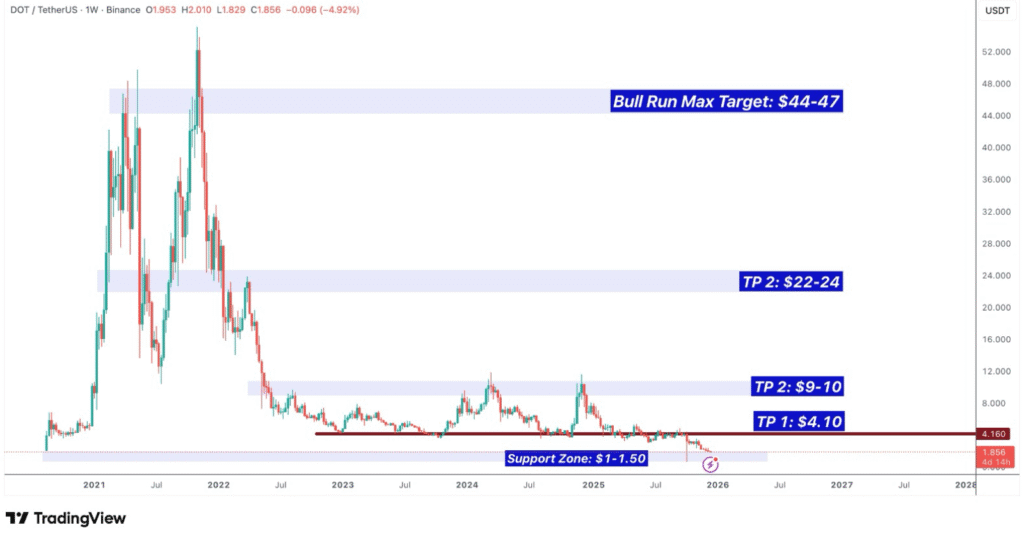
Below is a simplified projection table based on typical market cycles, broader crypto adoption, and Polkadot ecosystem growth.
| Category | Projected Price |
| Projected High | $10.47 – $27.20 |
| Average Price | $5.30 – $18.00 |
| Projected Low | $1.91 – $3.80 |
| Major Resistance Zone | $12.00 – $14.04 |
| Major Support Zone | $3.10 – $3.55 |
Polkadot (DOT) functions as a sharded multichain protocol that connects various specialized blockchains into a single unified network. Consequently, its primary growth driver for 2026 centers on the “Polkadot 2.0” rollout, which introduces flexible coretime allocation and enhanced interoperability. Furthermore, the network institutes a hard supply cap of 2.1 billion tokens in March 2026, transitioning the asset from an inflationary to a deflationary model. Although competition from other Layer-0 protocols remains fierce, these tokenomic shifts and the launch of the JAM protocol position Polkadot for significant institutional adoption.
Why Polkadot Outperforms its Rivals?
Polkadot competes with major networks such as Ethereum, Cosmos, Avalanche, Solana, and Cardano. Here’s why Polkadot stands out as a potential game-changer.
1. True Interoperability Across Multiple Chains
Polkadot enables seamless data and asset transfers between completely different blockchains, even if they use different technologies or architectures. This allows developers to create powerful applications that interact across ecosystems without limitations.
2. Shared Security Model
Unlike most blockchains, where each chain must secure itself, Polkadot allows parachains to share the high-level security of the Relay Chain. This significantly reduces development costs and prevents smaller chains from being vulnerable to attacks.
3. Highly Customizable Parachains
Developers can build tailored blockchains optimized for specific tasks without compromising performance. This flexibility attracts projects that need specialized environments rather than generic smart-contract platforms.
4. On-Chain Governance
Polkadot offers a community-driven governance model where DOT holders vote on upgrades and proposals. This system encourages decentralized decision-making and ensures the network evolves based on user interests.
5. Forkless Upgrades
Polkadot’s ability to upgrade without hard forks eliminates the risk of splitting the community or creating competing chains. This ensures smooth improvement, faster innovation, and long-term stability for developers and users.
6. Energy-Efficient NPoS
Polkadot is far more energy-efficient compared to proof-of-work blockchains. Its NPoS model allows scaling without harming the environment, making it future-friendly.
7. Robust Developer Ecosystem
The network attracts developers because of its modular framework, powerful SDKs, and ease of building parachains. This growth increases innovation and ensures the continuous expansion of the ecosystem.
8. Growing Parachain Market
With many active parachains delivering services across DeFi, gaming, identity, and real-world technologies, Polkadot is building a healthy interconnected digital economy.
Conclusion
Polkadot has established itself as one of the most advanced blockchain ecosystems with a strong focus on interoperability, scalability, and security. Its unique multi-chain architecture enables developers to build custom blockchains that seamlessly communicate with each other, creating opportunities far beyond what traditional blockchain networks can offer.
From decentralized finance to gaming, identity systems to supply-chain management, Polkadot’s parachains bring specialized solutions to life without sacrificing performance. The DOT token plays a central role by supporting governance, staking, and network utility, making it an essential asset for users who want to participate in the future of Web3.
Looking ahead, Polkadot’s technology, developer activity, and ecosystem growth position it as a blockchain network with long-term potential. As interoperability becomes increasingly important for real-world adoption, Polkadot stands as one of the leading platforms shaping the next generation of decentralized applications.
Disclaimer
Cryptocurrency markets are highly volatile, and investing in projects like Polkadot involves financial risk. The information in this article is for educational purposes only and should not be interpreted as financial or investment advice. Always conduct your own research, assess your risk tolerance, and consider consulting a licensed financial professional before making any investment decisions. Never invest more than you can afford to lose.
FAQs
How does Polkadot 2.0 change the network?
The upgrade replaces the old auction-based parachain system with a flexible coretime model. Therefore, developers can now purchase blockspace as needed, making the ecosystem more accessible for smaller projects.
What occurs during the DOT “halving” in 2026?
Starting in March 2026, the network reduces token issuance every two years. This schedule eventually leads to a hard cap of 2.1 billion tokens, which stabilizes long-term supply.
What primary role does the DOT token play?
Holders use DOT for three specific purposes: network governance, staking for security, and bonding to secure a parachain slot. Additionally, users need DOT for transaction fees across the Relay Chain.
How does the JAM protocol benefit the ecosystem?
The Join-Accumulate Machine (JAM) upgrade replaces the current Relay Chain with a more modular architecture. Consequently, it enables parallel processing of transactions, potentially reaching over one million transactions per second.
Is Polkadot truly decentralized?
Yes, because the community manages the network through the OpenGov system. Any token holder can submit or vote on proposals, ensuring that collective agreement drives every protocol change.