Monero (XMR) is one of the most well-known privacy-focused cryptocurrencies in the world. It is launched with a mission to provide secure, untraceable, and confidential digital transactions. Monero stands apart from most major blockchains, which are transparent by design. Unlike Bitcoin, Ethereum, and many other networks where anyone can view transaction details publicly, Monero ensures that every transaction is private by default, making it a preferred choice for individuals who value financial anonymity, personal freedom, and strong encryption.
In an age where digital surveillance and data exposure are increasing, Monero has positioned itself not just as a cryptocurrency but as a privacy technology. Its underlying protocols protect user identity, transaction amounts, and wallet balances. This makes XMR a unique asset in the blockchain ecosystem and a significant player in the future of privacy-centric financial systems.
History of Monero XMR
Monero originated in 2014 as a fork of Bytecoin, one of the earliest privacy-focused cryptocurrencies. However, concerns arose over Bytecoin’s distribution, as developers allegedly pre-mined a large coin supply. Therefore, the community forked the project to create a fair, transparent, and community-driven blockchain.
Key Historical Milestones
- 2014 – Launch: In 2014, Monero launched as “BitMonero” and later adopted the name Monero, meaning “coin” in Esperanto.
- 2016 – Major privacy upgrades: Subsequently, in 2016, the project introduced major privacy upgrades by implementing Ring Confidential Transactions (RingCT), which fully hid transaction amounts.
- 2017–2019 – Rapid adoption & exchange listings: Monero gains popularity for its privacy features and becomes widely supported across major trading platforms.
- 2020–2022 – Regulatory scrutiny: As global regulators increase oversight, privacy coins like Monero face delistings from several exchanges, reinforcing discussions around privacy rights and financial freedom.
- 2023 onward – Continuous upgrades: The Monero community regularly improves efficiency, security, and cryptographic algorithms, ensuring strong privacy without sacrificing functionality.
Monero remains fully community-driven, without a centralized foundation or corporate backing, making it one of the most decentralized and ethically aligned crypto projects.
How Does Monero Work?
Monero is built on a sophisticated privacy architecture that hides sender, receiver, and transaction amounts, three pieces of data that most blockchains make public.
Below are the core technologies behind Monero:
1. Ring Signatures
Ring signatures combine a group of possible signers, making it mathematically impossible to identify who authored a transaction. This protects sender anonymity.
2. Stealth Addresses
Stealth addresses generate a unique, one-time address for every transaction. This ensures:
- Your transactions never link to your public wallet address.
- Receivers remain fully anonymous
3. RingCT (Ring Confidential Transactions)
RingCT hides the amount being transferred. Even if someone sees the transaction on the blockchain, they cannot determine:
- How much XMR was sent
- The sender
- The receiver
4. Dandelion++ (Network-level privacy)
Monero hides the originating IP address of a transaction, preventing network-based surveillance.
5. RandomX (Mining Algorithm)
Monero uses RandomX, a CPU-friendly mining algorithm designed to:
- Resist ASIC dominance
- Maintain decentralization
- Allow ordinary users to mine from desktop devices
This aligns with Monero’s philosophy: financial privacy for everyone.
How to Buy Monero (XMR)
Buying Monero is slightly different from purchasing more transparent cryptocurrencies due to its regulatory scrutiny. However, it remains accessible through the following methods:
1. Cryptocurrency Exchanges
XMR is available on many well-known exchanges, though some regions may impose restrictions.Typical steps:
- Sign up and complete KYC (identity verification).
- Deposit fiat (INR, USD, EUR) or crypto like USDT/BTC.
- Search for the XMR trading pair (e.g., XMR/USDT).
- Execute a market or limit order.
2. Decentralized Exchanges (DEXs)
Some cross-chain DEX platforms enable users to swap crypto for XMR without centralized oversight. This method supports privacy-enhancing principles.
3. Peer-to-Peer (P2P) Trading
Users can buy Monero directly from others using:
- Cash
- Bank transfer
- Privacy-focused buyers widely use payment apps and P2P platforms.
4. Mining Monero
Instead of purchasing XMR, users can mine it using CPU hardware thanks to the RandomX algorithm. Mining rewards new XMR directly into your private wallet.
Price Prediction for Monero (XMR)
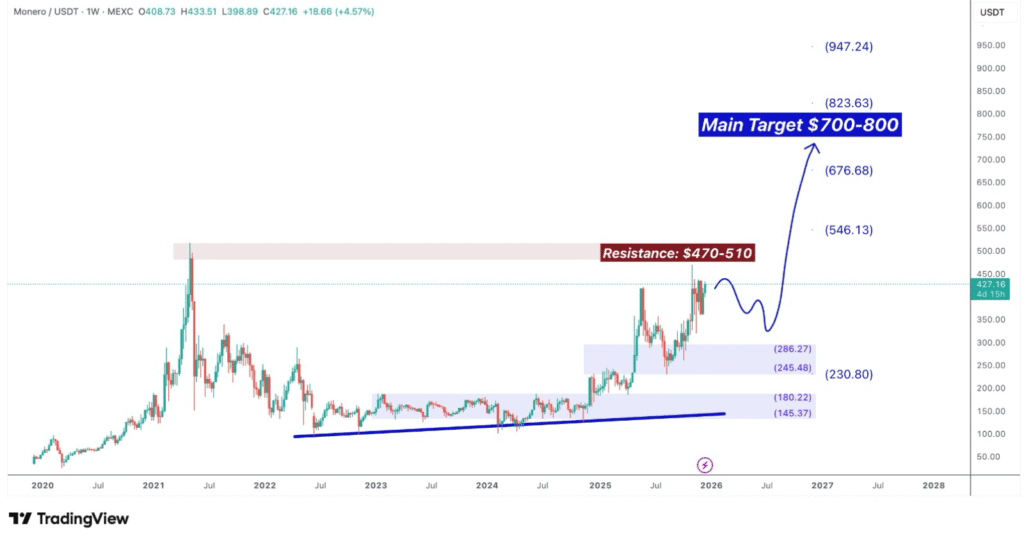
| Category | Projected Price (USD) |
| Projected High | $720.00 – $2,000.00 |
| Average Price | $430.00 – $470.00 |
| Projected Low | $130.00 – $320.00 |
| Resistance Zone | $420.00 – $500.00 |
| Support Zone | $360.00 – $395.00 |
Assumptions
Monero (XMR) remains the gold standard for financial privacy, utilizing advanced cryptographic features like stealth addresses and ring signatures to ensure transactions are untraceable by default. Heading into 2026, XMR is displaying a strong parabolic uptrend, with some analysts predicting a rally toward $2,000 if it can decisively break through the psychological $500 resistance. Despite facing regulatory pressure and delistings from major centralized exchanges, Monero has demonstrated unique resilience, often moving independently of broader market trends. Its utility as a fungible medium for private settlement continues to drive its intrinsic value.
Why Monero XMR Stands Out?
Monero competes with several privacy-focused coins, but it also indirectly competes with transparent blockchains when users seek anonymity.
1. Privacy by Default
Most crypto networks make privacy optional. Monero makes it mandatory, reducing human error and ensuring consistency.
Zcash, for example, requires users to manually choose shielded mode, and most do not—making ZEC less private in practice.
2. Unbreakable Cryptography
Monero’s combination of:
- Ring signatures
- Stealth addresses
- RingCT
- Dandelion++
To date, Monero has never been deanonymized at scale.
3. Strong Community & No Central Authority
Monero has:
- No CEO
- No foundation
- No centralized control
- No pre-mine
This ensures long-term ethical sustainability and censorship resistance.
4. ASIC-Resistant Mining (Decentralization)
RandomX ensures mining remains accessible to everyday users—not just industrial farms. This protects the network from control by wealthy miners.
5. High Fungibility
Because all XMR is indistinguishable, unlike Bitcoin, Monero is fully fungible:
- No blacklisting
- No tainted coins
- No transaction history tracing
This is critical in a future where financial privacy becomes a global priority.
6. Real-World Use-Cases
Monero is used for:
- Personal privacy
- Business confidentiality
- NGO payments in restricted regions
- Financial protection in high-surveillance countries
- Secure P2P transactions
Few privacy coins offer this level of practical adoption.
Conclusion
Monero (XMR) represents one of the most important innovations in the cryptocurrency world. Its commitment to default privacy, sound cryptography, decentralized governance, and real-world use cases sets it apart from almost all other digital assets.
As concerns over digital surveillance and data privacy continue to grow globally, Monero has positioned itself as a powerful tool for individuals and businesses who prioritize confidentiality and financial security.
Whether used for personal financial protection, humanitarian purposes, or secure business transactions, Monero offers a strong value proposition in a world where privacy is becoming increasingly precious.
While regulatory pressures may influence its accessibility, Monero’s technological robustness, devoted community, and widespread utility ensure that it will remain a critical part of the crypto ecosystem for years to come.
Disclaimer
Cryptocurrencies, including Monero (XMR), involve high market risk and price volatility. This article is for informational and educational purposes only and does not constitute financial advice. Always conduct your own research and consider consulting a qualified financial advisor before investing. Only invest what you can afford to lose.
Frequently Asked Questions
What makes Monero different from Bitcoin?
Unlike Bitcoin’s transparent blockchain, Monero obscures the sender, receiver, and transaction amount by default.
What is “Fungibility” in Monero?
Because every coin is untraceable, no XMR can be blacklisted or “tainted” by past transactions, making every coin equal in value.
How are transactions hidden?
Monero uses Ring Signatures to hide the sender, Stealth Addresses to hide the receiver, and RingCT to hide the amount.
Can Monero be mined by regular users?
Yes, its RandomX algorithm is ASIC-resistant, allowing efficient mining on consumer-grade CPUs.
Is Monero truly untraceable?
While some authorities attempt to trace it, Monero enforces privacy at the protocol level. Therefore, it stands as the most private major cryptocurrency.
Why was Monero delisted from some exchanges?
Many centralized exchanges (like Binance) delisted XMR to comply with evolving regulations regarding privacy coins.
What is the maximum supply of XMR?
Monero does not have a hard cap like Bitcoin; instead, it uses tail emission to ensure a constant, small reward for miners indefinitely.
Where can I buy Monero if it’s delisted?
XMR can still be traded on several platforms, like Kraken or through decentralized swaps and cross-chain bridges.
Who are the founders of Monero?
It was launched in 2014 by seven developers; five remain anonymous, reflecting the project’s focus on privacy.
What is the 2026 outlook?
The outlook is largely bullish due to high developer activity and its role as a hedge against digital surveillance, though it faces a major hurdle at the $500 price mark.