Cryptocurrencies have changed the way people see money. But while coins like Bitcoin and Ethereum are well-known, they are not always accessible to everyone. Mining them requires powerful computers, high electricity consumption, and technical knowledge. This is where Pi Coin, the native currency of the Pi Network, is different. It was created with one simple goal: to make cryptocurrency easy for everyone, even for people who only own a smartphone.
Let’s dive deeper into what Pi Coin is, how it works, and whether it has a future in the fast-growing crypto world.
What is Pi Coin?
Pi Coin is the digital currency of the Pi Network, a blockchain project launched in 2019. Unlike most cryptocurrencies, Pi can be mined on a mobile phone with no special equipment.
The idea behind Pi is financial inclusion. Billions of people around the world don’t have access to banking systems, but almost everyone owns a smartphone. By making crypto mining available on mobile, Pi allows more people to participate in the digital economy. For many, Pi Coin represents the first step into the world of cryptocurrencies.
History and Founders of Pi Network
The Pi Network was founded by a group of Stanford graduates:
Dr. Nicolas Kokkalis (an expert in decentralized technologies), Dr. Chengdiao Fan (a social computing researcher who wanted to connect people through technology), and Vincent McPhillip (an entrepreneur passionate about crypto adoption).
They noticed that Bitcoin’s mining had become too centralized and expensive. With Pi, they wanted to build a user-friendly alternative that anyone could join without financial barriers.
The project started in 2019 and quickly gained momentum. Within a few years, Pi Network grew to tens of millions of users, called Pioneers, making it one of the largest crypto communities in the world.
How Pi Coin Works?
Pi Coin does not use Proof of Work like Bitcoin. Instead, it relies on the Stellar Consensus Protocol (SCP).
Here’s how it works in simple terms:
Mobile Mining: Users mine Pi coins simply by tapping a button on the app once every 24 hours. The process doesn’t consume battery or data.
Security Circles: Each user builds a small group of trusted members called a security circle. This helps validate transactions and keep the network secure.
Energy Efficiency: Since no heavy computation is required, Pi mining is energy-friendly and accessible for anyone with a smartphone.
This unique model allows Pi to be mined without the environmental concerns of traditional cryptocurrencies.
Use Cases of Pi Coin
While Pi is still under development, its planned ecosystem looks ambitious. Some possible applications include:
- Peer-to-Peer Payments: Users will be able to send and receive Pi instantly. Imagine paying for groceries or splitting bills with Pi.
- Pi Marketplace: Developers are building apps where Pi can be used to buy goods and services.
- E-Commerce Integration: The Pi Network aims to connect merchants who accept Pi as a payment method.
- Cross-Border Transactions: Pi could make international money transfers faster and cheaper compared to banks or traditional remittance services.
These use cases, if successful, could make Pi a practical cryptocurrency for daily life.
Advantages of Pi Coin
Pi Coin brings several unique benefits compared to older cryptocurrencies:
- Accessibility: Anyone with a smartphone can mine Pi without extra costs.
- Energy Efficiency: Unlike Bitcoin, Pi does not consume huge amounts of electricity.
- Mass Adoption Potential: With millions of users already mining, Pi has a massive global community.
- Inclusivity: It opens the door for people in developing nations who cannot access traditional banking.
Challenges of Pi Coin
- Not Fully Launched: Pi is currently in the enclosed mainnet phase, meaning it’s not available for public trading.
- Unlisted on Exchanges: Since Pi is not yet on major exchanges, it has no official market price.
- Uncertain Value: Its future value depends on adoption after launch.
- Criticism: Some critics worry it may not deliver on its big promises.
How to Get Pi Coin
Unlike other cryptocurrencies, you cannot buy Pi on exchanges yet. The only way is through the Pi Network mobile app.
Steps to start mining:
- Download the app from the Google Play Store or Apple App Store.
- Register with an invitation code.
- Tap the mining button daily to earn Pi.
- Build your security circle by inviting trusted people.
- Continue mining until the open mainnet launch, when Pi can be traded.
Mining Pi feels more like participating in a community project than traditional mining.
Pi Coin vs Bitcoin
Let’s compare Pi with the king of cryptocurrencies, Bitcoin:
| Feature | Pi Coin | Bitcoin |
| Launch Year | 2019 | 2009 |
| Mining Method | Mobile mining (SCP) | Proof of Work |
| Accessibility | Easy – anyone with a phone | Expensive mining rigs |
| Energy Use | Minimal | Very high |
| Exchange Listing | Not yet | Traded globally |
This comparison shows Pi is designed for accessibility, while Bitcoin remains resource-intensive.
Pi Network (PI) Price Predictions
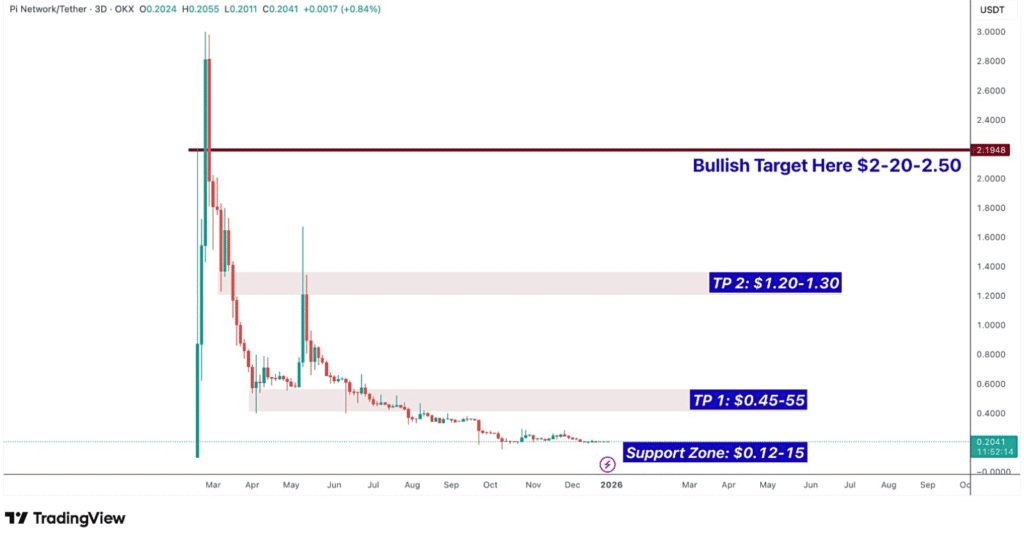
| Category | Projected Price (USD) |
| Projected High | $0.30 – $3.50 |
| Average Price | $0.24 – $2.25 |
| Projected Low | $0.14 – $0.85 |
| Major Resistance Zone | $0.21 – $0.41 |
| Major Support Zone | $0.19 – $0.21 |
Pi Network (PI) enters 2026 focused on its “Open Network” era following the 2025 mainnet launch and initial exchange listings. Currently, the network’s growth depends on the successful rollout of Protocol v23, which integrates Stellar Core v23 for smart contract support. Furthermore, the launch of a native Pi DEX aims to enable peer-to-peer trading directly within the ecosystem. While a massive unlock of over 1 billion tokens scheduled for 2026 creates significant selling pressure, the core team continues to deploy a $100 million ventures fund to boost utility-driven apps. Most analysts expect price action to remain range-bound until real-world utility and broader exchange liquidity absorb the supply overhang.
The future of Pi Coin depends heavily on its upcoming open mainnet launch. If successful, Pi could:
- Compete with other digital payment systems.
- Become a currency for e-commerce platforms.
- Attract developers to build decentralized apps (dApps).
- Empower users in countries with limited banking systems.
How to Calculate Pi Coin Profits
Formula to calculate Pi Coin:
Profit = (Selling Price – Buying Price) × Number of Pi – Fees
Example:
If Pi launches at $5 and you mined 2,000 Pi, then:
- At $5, your value = $10,000.
- If price rises to $10, value = $20,000.
These are only assumptions. Actual prices will depend on market demand.
Risks Involved in Pi Coin
Like any cryptocurrency, Pi carries risks:
- Uncertain Timeline: No fixed date for its open mainnet.
- Speculative Price: Could rise or fall sharply after launch.
- Limited Liquidity: Until exchanges list it, trading options are limited.
- Regulatory Barriers: Some countries may restrict their usage.
Disclaimer
This blog is for educational purposes only and does not provide financial advice. Cryptocurrencies are highly volatile and risky. Pi Coin is still in development, and its future value is uncertain. Always do your own research (DYOR) and consult professionals before making investment decisions.
Frequently Asked Questions
What is Pi Coin and how does it work?
Pi Coin is a mobile-mined cryptocurrency that allows users to earn coins through daily app activity without high energy usage.
Is Pi Coin officially launched on mainnet?
Pi Network has launched its enclosed mainnet, with open mainnet access planned as ecosystem readiness improves.
How is Pi Coin mined on mobile phones?
Pi Coin uses a trust-based consensus system where users validate each other rather than solving complex computations.
Does Pi Coin have real-world use cases?
Pi aims to support peer-to-peer payments, digital services, and marketplace transactions within its ecosystem.
Is Pi Coin listed on major crypto exchanges?
Pi Coin is not officially listed on major exchanges; unofficial listings are not supported by the Pi Network team.
Who is developing Pi Network?
Pi Network is developed by a team of Stanford-educated computer scientists focusing on mass crypto adoption.
What is Pi Coin’s total supply?
Pi Coin does not have a fixed publicly confirmed supply, as distribution depends on user participation and network growth.
Can Pi Coin be transferred or sold?
Transfers are limited to verified users within the Pi ecosystem until open mainnet launches.
Is Pi Coin safe or risky to hold?
Pi Coin carries uncertainty due to limited liquidity, evolving utility, and delayed exchange listings.
What could impact Pi Coin’s future value?
Open mainnet launch, real-world adoption, exchange listings, and regulatory clarity will influence Pi Coin’s value.